MENU
Peer Review Process
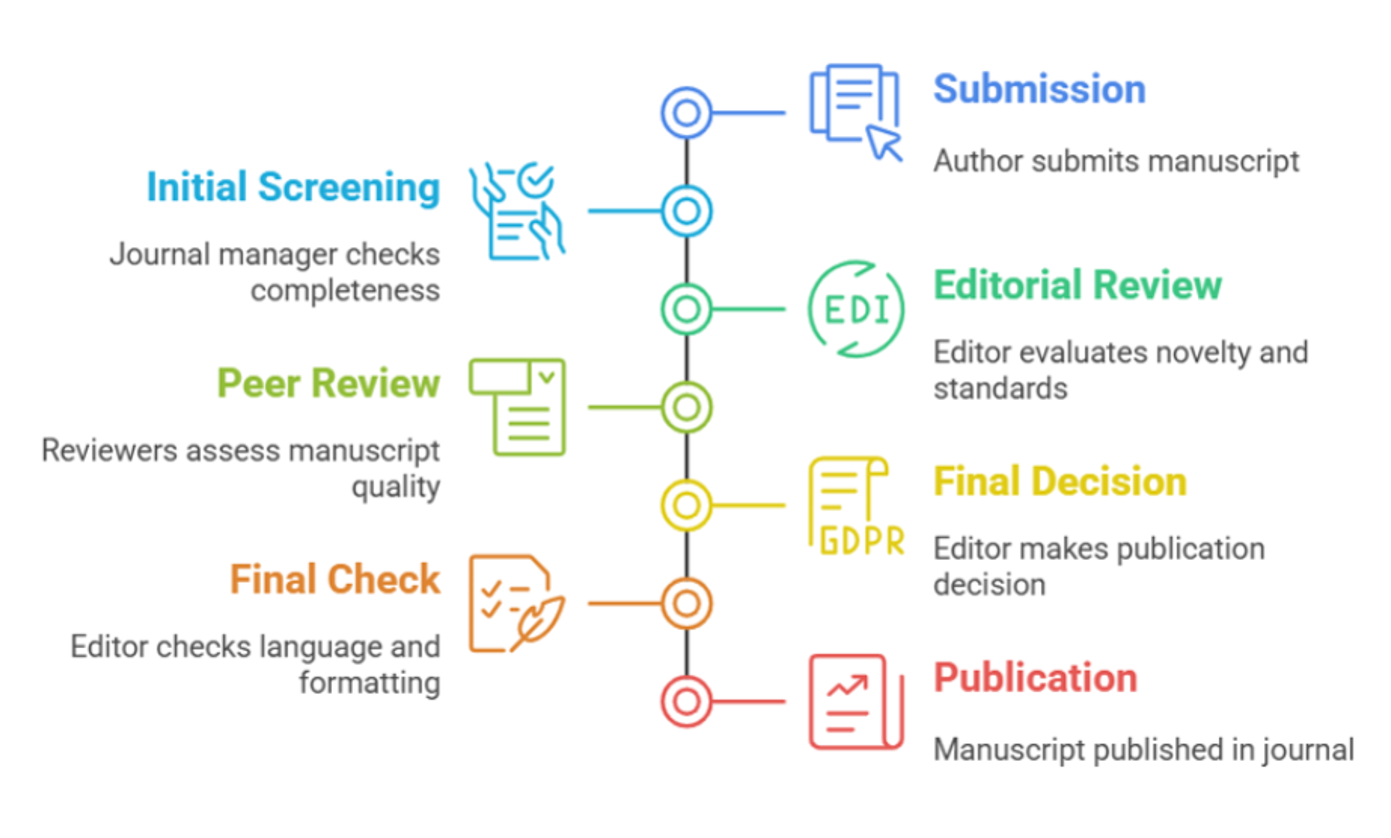
The image illustrates the peer review workflow of a scientific journal, which consists of several systematic stages as follows:
- Submission
The process begins when the author submits the manuscript through the journal's online system. The submitted manuscript must be complete and comply with the prescribed writing guidelines. - Initial Screening
The journal manager or editorial staff checks the completeness of the manuscript, including format compliance, the presence of essential components (such as abstract, references, tables/figures), and adherence to the journal's policies. - Editorial Review
The editor is responsible for evaluating the manuscript's novelty, topic relevance, academic quality, and suitability to the journal’s scope. If the manuscript does not meet the basic criteria, it may be rejected at this stage. - Peer Review
Manuscripts that pass the editorial screening are sent to at least two reviewers who are experts in the relevant field. Reviewers assess the methodological quality, data accuracy, scientific contribution, and strength of the arguments. This process follows a double-blind review system, where both authors’ and reviewers’ identities are kept confidential. - Final Decision
After receiving feedback from the reviewers, the editor considers all input and decides whether the manuscript will be accepted, revised (minor or major), or rejected. The author will receive a decision letter along with reviewer comments for revision if required. Once revisions are completed, the author must resubmit the manuscript via the OJS system for further review by the editor and reviewers. - Final Check
If the manuscript is accepted, the editor conducts a final check focusing on language use, reference formatting, layout consistency, and compliance with publication standards. - Publication
Manuscripts that have passed all previous stages will be officially published in the journal’s edition, available in both online and print versions, and accessible to the scientific community.
This process is designed to ensure that every article published maintains high scientific standards, is free from plagiarism, and makes a significant contribution to the advancement of knowledge and professional practice in the fields of physics and physics education.